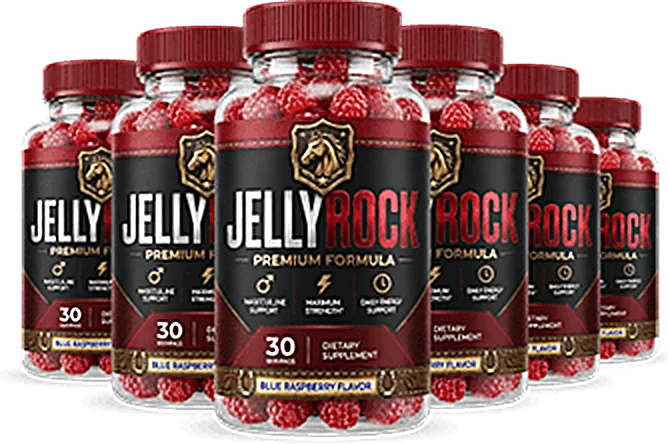
Jelly Rock Review: Our Full Independent Assessment
Jelly Rock is a real, active brand with a genuinely layered ingredient design, let down mainly by undisclosed dosing and a tighter-than-ideal margin on the smallest package.
If those two gaps do not concern you and the ingredient profile fits what you are looking for, it is a defensible purchase — especially in the 3 or 6-bottle bundle.
What Jelly Rock is
Jelly Rock is a daily Blue Raspberry chewable gummy marketed to adult men, built around six named ingredients: L-Citrulline, L-Arginine, Horny Goat Weed, Tribulus Terrestris, Panax Ginseng and zinc. It is sold direct-to-consumer in 2, 3 and 6-bottle bundles, priced from $79 to $49 per bottle, with a 60-day money-back guarantee.
What genuinely holds up
A dual amino-acid circulation pathway. L-Citrulline and L-Arginine both feed nitric oxide production, a more thoughtful design than a single-ingredient competitor — see our piece on nitric oxide.
Zinc is well-chosen. Of everything on this label, zinc has the clearest human evidence connecting deficiency correction to healthy testosterone.
Horny Goat Weed targets a real, complementary pathway. A traditional botanical with an identifiable active compound (icariin), adding a second circulatory route — see our piece on Horny Goat Weed.
Genuinely non-stimulant. No caffeine named in the ingredient list, a real difference from some competing ‘vitality’ products that lean on stimulants.
The gummy format solves a real compliance problem. See our piece on format for the honest trade-off.
What does not hold up as well
No per-gummy dosing disclosed anywhere we could find. This is the central weakness. You cannot verify whether the L-Citrulline here approaches research-level amounts or falls well short. Full detail in undisclosed dosing, explained.
A tighter guarantee-versus-timeline margin on the 2-bottle package. The brand states fuller benefits around week six, and the 2-bottle (60-day) package covers roughly eight to nine weeks — workable, but with less buffer than the larger bundles.
Unverified review sourcing. The brand's displayed rating and testimonials come from its own pages; we could not locate an independent platform hosting or auditing them.
No confirmed legal operating entity on the pages we reviewed — not unusual for a newer direct-to-consumer brand, but worth a quick question to support if it matters to you.
Pricing and value
At $79 per bottle for the 2-bottle package, this is the least efficient entry point. At $49 per bottle on the 6-bottle bundle, pricing is reasonable for a category built around named, layered ingredients.
Who it suits
Adult men who want a layered, non-stimulant vitality formula alongside genuine basics — sleep, training, sensible eating — who are comfortable ordering direct-to-consumer without confirmed per-gummy dosing, and who plan from the outset to buy the 3 or 6-bottle bundle rather than testing with the smallest size.
Who should skip it
Anyone who needs per-gummy dosing confirmed before trying any supplement. That information is not published here.
Anyone on blood pressure or heart medication who has not yet spoken to their doctor — the formula's circulation-focused mechanism warrants that conversation first.
Anyone planning to rely on the 2-bottle guarantee as a leisurely trial. The margin against the brand's own six-week timeline is tighter on that package than on the larger bundles.
Anyone looking for a clinically supervised testosterone program. This is a direct-to-consumer wellness supplement, not a physician-managed treatment.
The verdict
Jelly Rock is a competently assembled formula sitting on a genuinely layered theory — two amino acids for circulation, a botanical complement, hormonal-support minerals, and a non-stimulant energy adaptogen. Its ingredient choices, particularly the dual nitric-oxide pathway and zinc inclusion, are more thoughtful than a lot of single-ingredient competition.
What keeps it from a stronger recommendation is transparency: undisclosed dosing and a smallest package that leaves less room than ideal against the brand's own six-week timeline. Neither is a red flag on its own, but together they mean you are trusting the brand more than verifying the product — and that is worth going in with your eyes open about.